Showing posts with label Facebook. Show all posts
Showing posts with label Facebook. Show all posts
28 May 2013
Social Abstinence
On Saturday evening, I've officially stopped using Facebook, Twitter and G+.
The reason is that I was sucked into socialmedia-overload by certain political events back in my home town (i.e. a referendum). I unofficially took over a troll-cleaning role and started enjoying the keyboard-warrior role a bit too much. I recognised, halfway through, that my engagement had gone way beyond sane levels. I forced myself to promise that, once the situation was over, I'd stop living on the internet and reassess my life priorities. The night before the referendum was due to be hold, I posted a goodbye status on Facebook, and logged off. Then I went on twitter to say what I'd done, and thought I might as well go the extra mile and quit that as well as G+.
"We" won that referendum. I like to think that I helped, if just a little bit. Now it's time to re-establish some focus on my own priorities, look outside the window, be a better dad, exercise regularly, that sort of thing.
If you need me, for the next few months please use email or any other instrument developed in the XX Century. Thank you.


17 December 2012
Why I've never really liked the Facebook API
The other day, I got an email from Virgin Media stating that my connection had been "upgraded to 100Mb/s". I went to a bunch of speed-testing websites, and reported speeds were indeed much higher than in the past. I was tempted to brag about it on Facebook then I remembered that, last time I did something similar, I was humbled by a bunch of Dutch friends with "big pipes". I wondered what sort of speed they reported then, so I went to Facebook to search for that old status. And that's where my problems started.
The standard FB search UI failed to return anything even vaguely related, as usual. So I started googling for apps that would allow me to search my previous posts, and found a few which just wanted to gather all my personal data (on FB -- you don't say!). Then I found that you can actually request a complete download of all your data from FB (under Settings) and launched the request, but it looked like it would take a long time (for the record, I finally got it about 24 hours later). So I thought "hey, surely I can work with the FB API". How naive of me!
There is, in fact, a straightforward API call to get your statuses: /me/statuses. By default, it will return some 25 records, and links to further paginated results. Except pagination is ridiculously buggy: after the first 50 records, it will just return a blank page. If you try to use the limit parameter, it will return a maximum of 100 records per page, and again it will stop after the second page (i.e. max 200 results, which it's actually 199 because everybody knows "there are only two hard things in computer science"). Time-based parameters (until, since) didn't seem to work at all. Using wrappers rather than direct calls didn't seem to make any difference. Being very late, I gave up and went to sleep.
A day later, still incredulous and obviously fairly frustrated, I googled harder and finally found a relevant question on StackOverflow, which pointed to a Facebook bug about pagination. As the bug says, you can work around the problem by always using offset rather than relying on 'next' and 'previous' links returned in JSON responses. I verified and that's actually the case. By now, my export was available for download anyway. You can imagine how happy I am (not).
Lessons learnt from this whole debacle:
- The unofficial facebook-sdk for python doesn't work with Python 3. There is an experimental fork with very limited testing (i.e. it passes 2to3 and that's it).
- the
jsonmodule in Python 3 Standard Library, as used by facebook-sdk, chokes on Facebook data. Don't even ask me how I found out. Trying with a more up-to-date version from the original upstream doesn't help. There is a Python 3 fork which didn't help. Juggling between json.load and json.loads didn't seem to help, and I didn't want to rip the guts out of facebook-sdk in fear of dropping compatibility with 2.x (although I cringed at times: using "file" as variable name? Really?). No wonder @kennethreitz rolled his own JSON parser in Requests. - facebook-sdk should probably be rewritten from scratch in Python 3 using Requests. Not that I'll ever do it.
- After so many years and botched revamps, the Facebook API is still terrible. For something reportedly so essential to "2.0" internet infrastructure, and with so many uber-smart people on their payroll, the whole thing still feels incredibly hackish.
23 March 2011
Social experiments with Facebook IDs
Having just watched "The Social Network", I stumbled on a post on Twitter pointing to graph.facebook.com, the free API you can use to scrape the shit out of FB (well, almost).
Turns out the API will work with IDs. Since FB started as a Harvard-only site, the first few hundred users were all Harvard alumni, obviously. So I started thinking about simple experiments like finding the most popular surnames, certain of having my class-based prejudices reinforced by loads of Winklevoss-style "aristonames". Turns out the most common names are actually Asian -- the elites of tomorrow, of course.
That's the issue, isn't it? Harvard is (supposedly) a top institution, churning out the "elites of tomorrow"; they won't all become Mark Zuckerberg, but they probably won't be homeless either.
So, as a joke, I wrote a script looking for Wikipedia pages dedicated to the first 1000 users of Facebook. Turns out there are a lot of very common names, which obviously result in false positives; unfortunately Wikipedia doesn't give you easily-parsed metadata (here's a new project for Jimbo Wales and friends), so I couldn't do things like discarding everyone born before 1970. With a bit of patience, I narrowed down the number to a rough 6%. Some of them are (or were) Facebook employees, of course, but there are also young poets, writers and comedians.
You would probably get better results by replacing Wikipedia with LinkedIn, which would include more successful businesspeople and professionals -- Harvard's bread and butter. Obviously you could also start digging across the entire FB userbase, beyond the first lucky Harvardites.
These web APIs are a great tool for smart researchers; you now have a lot of data to be correlated with a little bit of programming glue and very little time. The result might not be scientifically exact, but could still unearth surprising insights.
13 November 2008
Please stop spamming FB apps
Seriously, this is getting ridiculous:
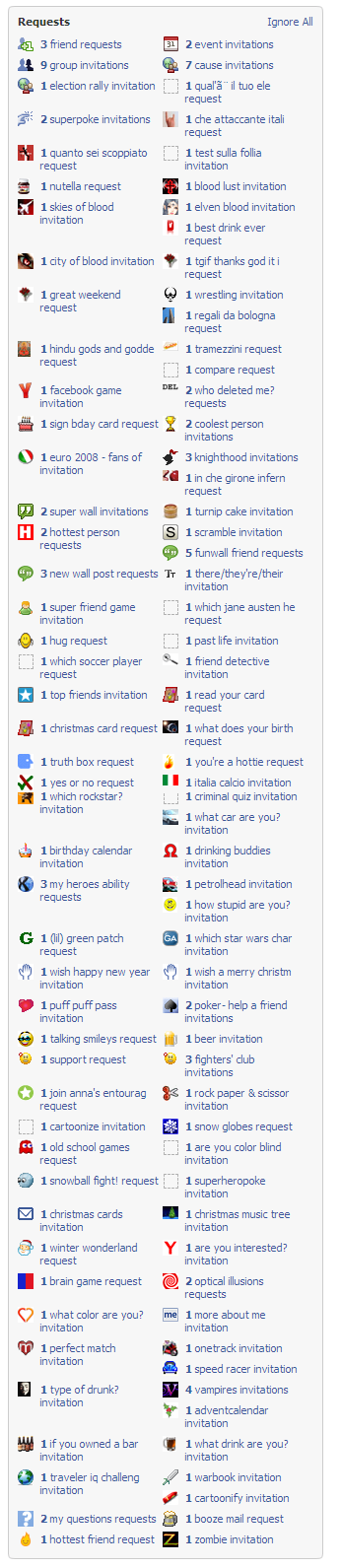
Every time you add a FB application, a third party gets access to your data, so I stopped accepting all invitations.
10 November 2007
Subscribe to:
Posts (Atom)